Pole dance in Tel Aviv
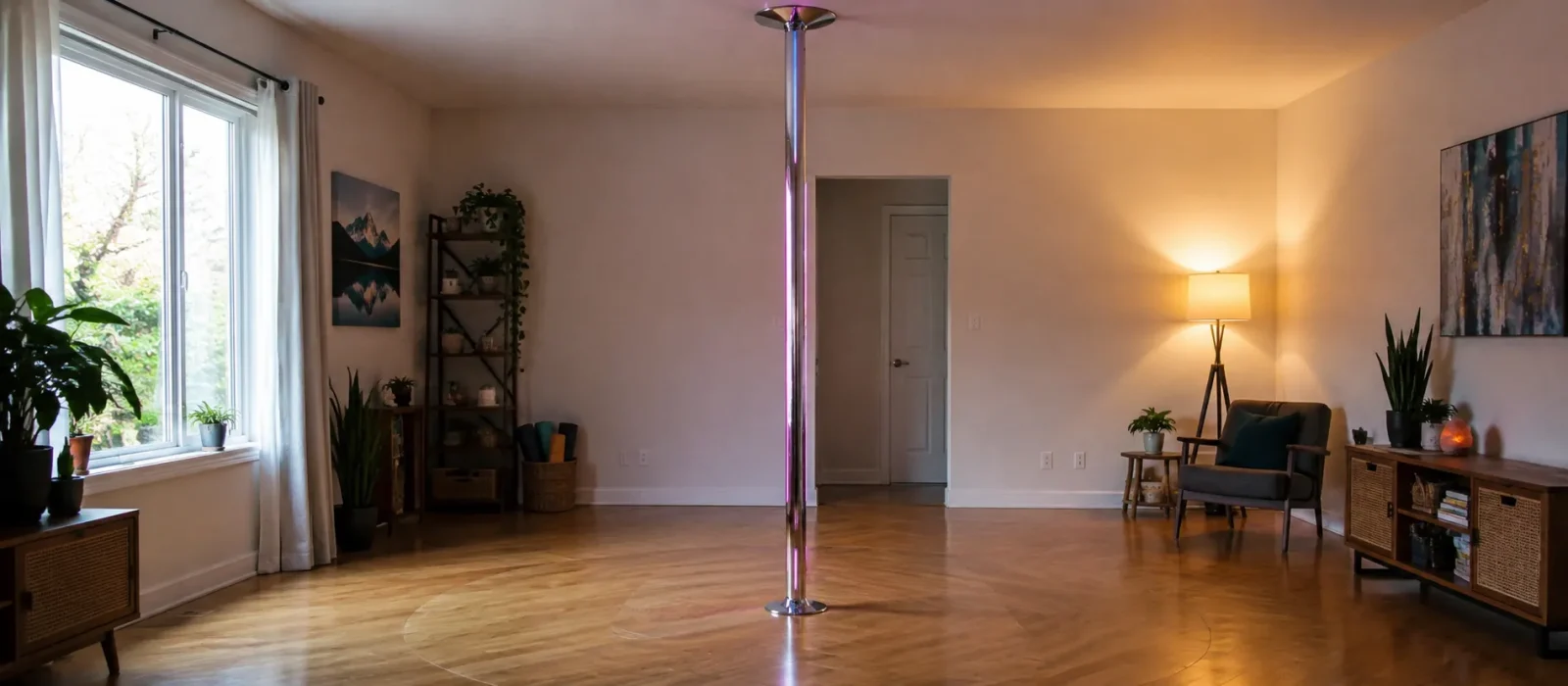
Pole is the only style with a hard physical requirement: a sound pole and a clear circle of about a metre and a half around it. No pole means chair choreography instead.
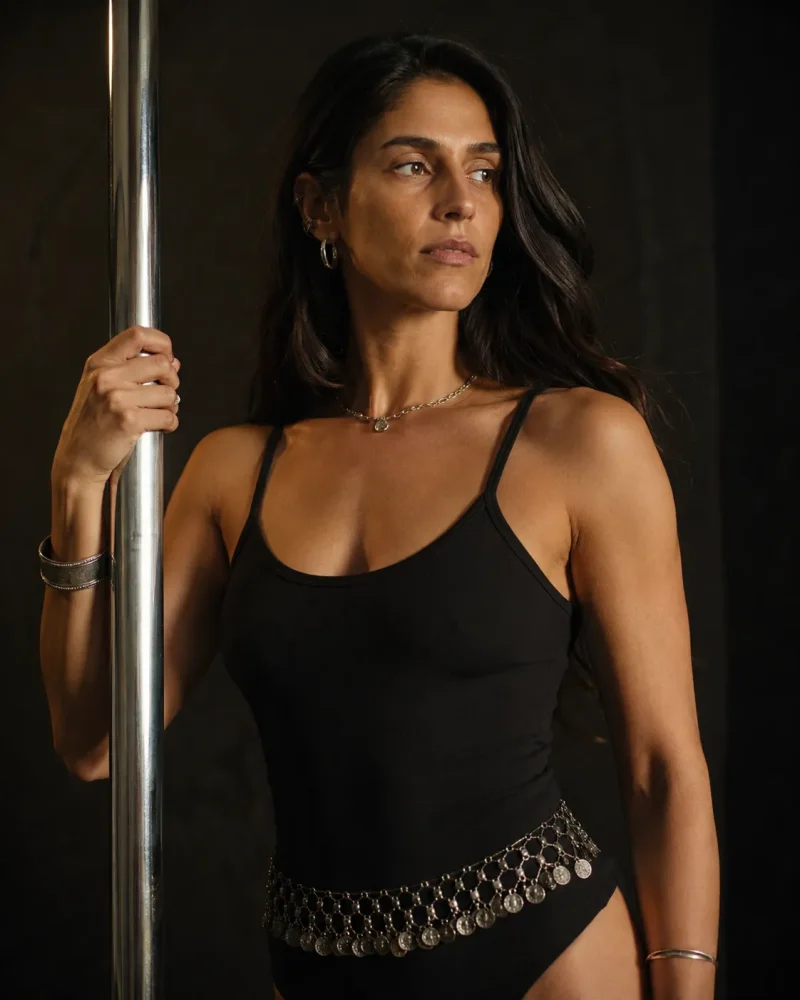
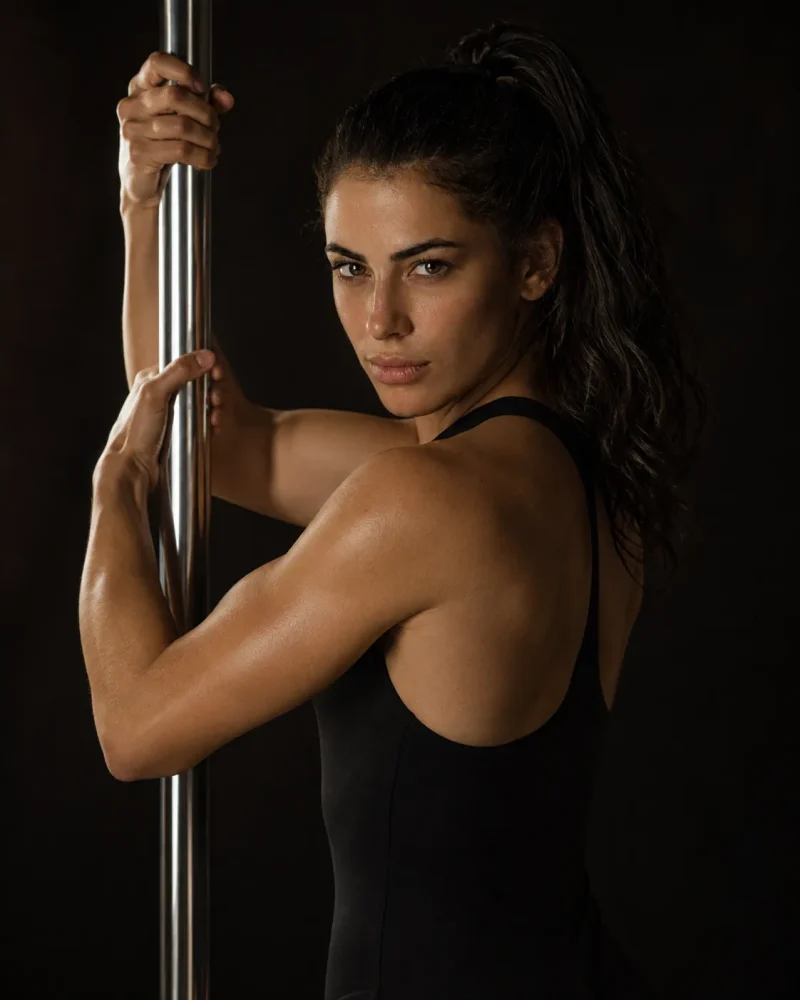

The only style with a hard physical requirement
Every other style we offer needs a floor and two metres. Pole needs a pole, and that is a condition rather than a preference. No pole, no pole dance, and we will tell you that in the first message rather than on the night.
Because of that this page is built differently from every other style page here: most of it is about what counts as a sound pole, how it gets checked and what happens when there is not one. The artistic side comes at the end, because in practice the practical question decides whether the show happens at all.
Which poles work and which are dangerous
Three kinds, and only one of them is genuinely safe.
A professionally mounted pole. Bolted to the floor and ceiling, or at least to the ceiling with a plate. This is what studios have, and occasionally a private house where somebody trains. We work on it without reservation.
A pressure-mounted pole. Held between floor and ceiling by tension, no bolts. This is the common one in homes and it can be perfectly sound — if it was installed correctly, if the ceiling above it is solid rather than plasterboard, and if somebody tightens it from time to time. A pressure pole installed two years ago and untouched since is not a pole, it is a risk.
A decorative pole or a pipe. Set-dressing poles, curtain rails, exposed water pipes. These are not performance poles even when they look identical. Nobody climbs them.
How to tell what you have: if it moves when you push it, if it spins freely without locking, or if the ceiling above it sounds hollow, it is a pressure pole that needs attention before the show.
The check before the show
This is the important moment of the evening, and it is worth knowing about in advance so it does not come as a surprise.
The dancer checks the pole herself before starting: shakes it, loads weight onto it, tests the spin. It takes a minute. If something is wrong she says so and moves to chair choreography — and that decision is hers alone, with no negotiation and no approval needed from us.
This is not excessive caution. A pole trick puts the whole body weight on a single point, sometimes spinning and sometimes upside down. A pole that lets go mid-move is a real injury, and no show is worth that. People who understand it beforehand are not disappointed; people who do not are disappointed at exactly the wrong moment.
What you can do in advance: tighten the pole on the day, clean the dust and any oil off it, and put nothing on it. Even hand cream on a pole makes it slippery.
Ceiling and the space around it
A standard ceiling of two and a half to two metres seventy works without any trouble. A higher ceiling, as in a Florentin loft, opens more up — higher climbs and longer descents.
Around the pole you need a clear circle of about a metre and a half in every direction. That is more than most people expect: legs travel a long way in a spin, and furniture in the corner becomes an obstacle. A coffee table left where it was is the single most common reason a set gets cut down.
The audience sits outside that circle, not inside it. That is both safer and better to watch.
Where poles actually exist
Less often than you would think, and we see it in the bookings.
Flats in central Tel Aviv almost never have one. In Neve Tzedek it is impossible — listed houses, and a hundred-year-old ceiling will not hold a pole. Where they do exist: private houses in Holon, Modiin and Kfar Saba, industrial lofts, and occasionally cabins where one was installed deliberately.
If you are renting a venue for the evening and want pole, ask the owner directly and pass us the answer. "I think there is something like that" is not enough for us to send a dancer who has built the whole set around it.
No pole? What happens then
We move to chair choreography, and that is different work rather than a reduced version.
Pole dancers are usually the physically strongest of the group, and it shows without the pole too: body control, long lines, slow transitions that take real strength. What disappears is the height and the spin. What remains is a great deal.
So if you want the dancer rather than specifically the pole, book without worrying. If you wanted exactly what you saw in a video with a pole in it, better to find a venue that has one.
Two worlds inside one style
Worth knowing before you book, because the difference is large.
Athletic pole. Close to sport: strength, tricks, control. Impressive for any audience including a mixed one, and sometimes booked precisely because it is less explicit than most of what is on this site.
Sensual pole. Slow, close to the floor, more movement and less acrobatics. Similar in character to lap dance but with the pole at the centre.
Tell us which one you are picturing and we will suggest accordingly. Both are booked with us, and not every dancer performs both.
How long, and why not the whole booking
A pole number runs three to five minutes. It is a high physical effort, higher than any other style we offer, and it cannot be sustained continuously.
A solo booking of forty-five to sixty minutes usually contains two of them, with other styles filling the rest. Anyone asking for a full hour of pole gets an honest answer from us: it will not happen, and if somebody promises it, it is worth asking them how.
Where people book it
Based on what actually exists: Florentin lofts, and private houses in Holon, Modiin and Rishon LeZion. A cabin with a pole is also something people choose deliberately.
To see who performs pole, look through the catalogue with styles, or simply tell us what kind of pole you have and the ceiling height. The price follows the format rather than the style and is on the prices page.
What a show costs Pole dance
Pick the costume in advance
You pick the costume in the message and she brings it, at no extra charge. Want something not on the list? Ask, we can usually arrange it.
- Nurse
- Cowgirl
- Waitress
- Teacher
- Flight attendant
- Secretary
- Maid
- Cat
A dancer for any occasion
What people ask Pole dance
A pole. That is a condition rather than a preference. A professionally mounted pole, or a sound pressure pole that has been tightened recently. A curtain rail or a water pipe is not a pole.
Usually yes, on three conditions: it was installed correctly, the ceiling above it is solid rather than plasterboard, and somebody tightens it from time to time. A pole untouched for two years needs tightening before the show.
She moves to chair choreography. That decision is hers alone, with no negotiation. A pole trick puts the entire body weight on one point, and a pole that lets go is a real injury.
A standard ceiling of 2.5 to 2.7 metres is enough. A higher one opens up climbs and long descents. Around the pole you need a clear circle of about a metre and a half in every direction.
Then you book the dancer for chair choreography, which is different work rather than a reduced version. Pole dancers are the physically strongest of the group and it shows without the pole too.
No. A pole number runs three to five minutes and the physical effort is higher than in any other style. A forty-five to sixty minute booking usually contains two, with other styles filling the rest.
The price follows the format rather than the style: 800 shekels solo, 1,400 duo, 2,200 for the VIP format, including travel, costume and music. Cash at the end of the show.
We cover the whole metro
What else they do
A built performance with an entrance, a peak and an ending. The reveal is the punchline rather than the content.
High energy with tempo and a crowd. It suits big groups who want something to happen rather than to watch quietly.
An entrance in character before anyone works out what is happening. The strongest style for a surprise.
Belly dance and eastern movement. It plays well to a mixed room and to events with character.
A clean line, movement close to dance, nothing crude. The one style you can put in front of a mixed group.
Leather, latex and a harness. An aesthetic rather than a session: a character, a costume and an atmosphere.
Continuous dancing with no single dramatic peak. You can step in and out of watching it.
The most intimate format. The dancer works centimetres away, with no stage and no distance.
Salsa and bachata at high energy. Plenty of interaction with the room, not only the guest of honour.
A slow set from an experienced dancer. Less acrobatics, more control of the room and the tempo.
A fifties aesthetic: retro, playful and never crude. It suits events that want light rather than heavy.
A set from a dancer with a full figure, with no apology and no hiding. Confidence is half of it.
An outdoor set on a deck or beside a pool. Movement adapted to a surface that moves, daylight instead of dark.
Want a Pole dance?
Tell us the style and the time and we will say who is available.