Latino in Tel Aviv
Samba, bachata, warm music and a rhythm that does not stop. Plenty of hip work and plenty of eye contact. Works beautifully on terraces and at summer events.



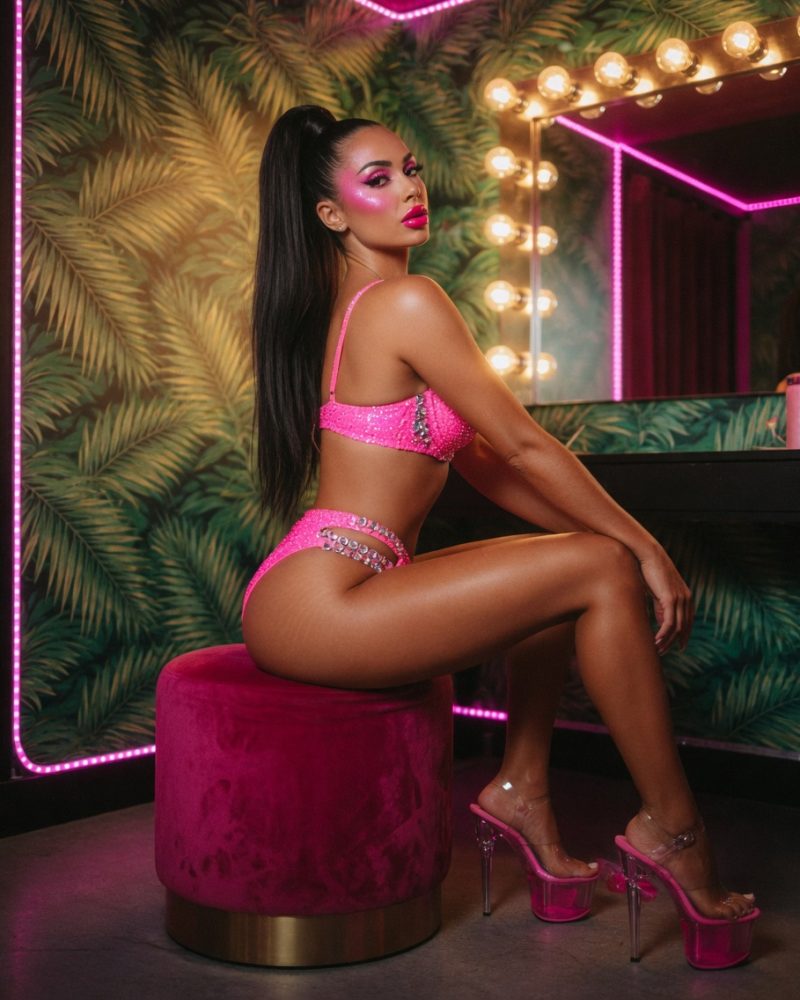
A latino set: what it actually is
Latino is the only style we run that comes out of partner dancing. Salsa, bachata, a little samba: all of them were born as dances for two, and even performed solo they keep the habit of facing outward rather than inward.
You notice it straight away. There is a lot of eye contact, continuous hip work, and a sense that the set is talking to the room rather than happening in front of it. The tempo is warm and does not stop, but it is not the mechanical tempo of go-go; it breathes.
On the restraint scale it sits somewhere in the middle of our catalogue: more physical than fashion, far less direct than lap dance.
The only style guests can take part in
This is the part that surprises people most, and it follows directly from the partner origin.
In every other style we run, guests watch. In latino the dancer can bring someone out for a few bars: lead two steps, turn them, put them back. It lasts under a minute, it always starts with her rather than with the guest, and it is almost always the moment the group talks about the next day.
The rules around it are fixed. She leads, she chooses who, and she ends it. If you want the guest of honour brought out, tell us in advance so she knows which way to look. If you would rather nobody was pulled out at all, we pass that on too, and that is entirely fine.
Because of that moment the style works well at birthdays and at evenings for couples, and less well at a bachelor party where the group is already drunk and past the point where this lands.
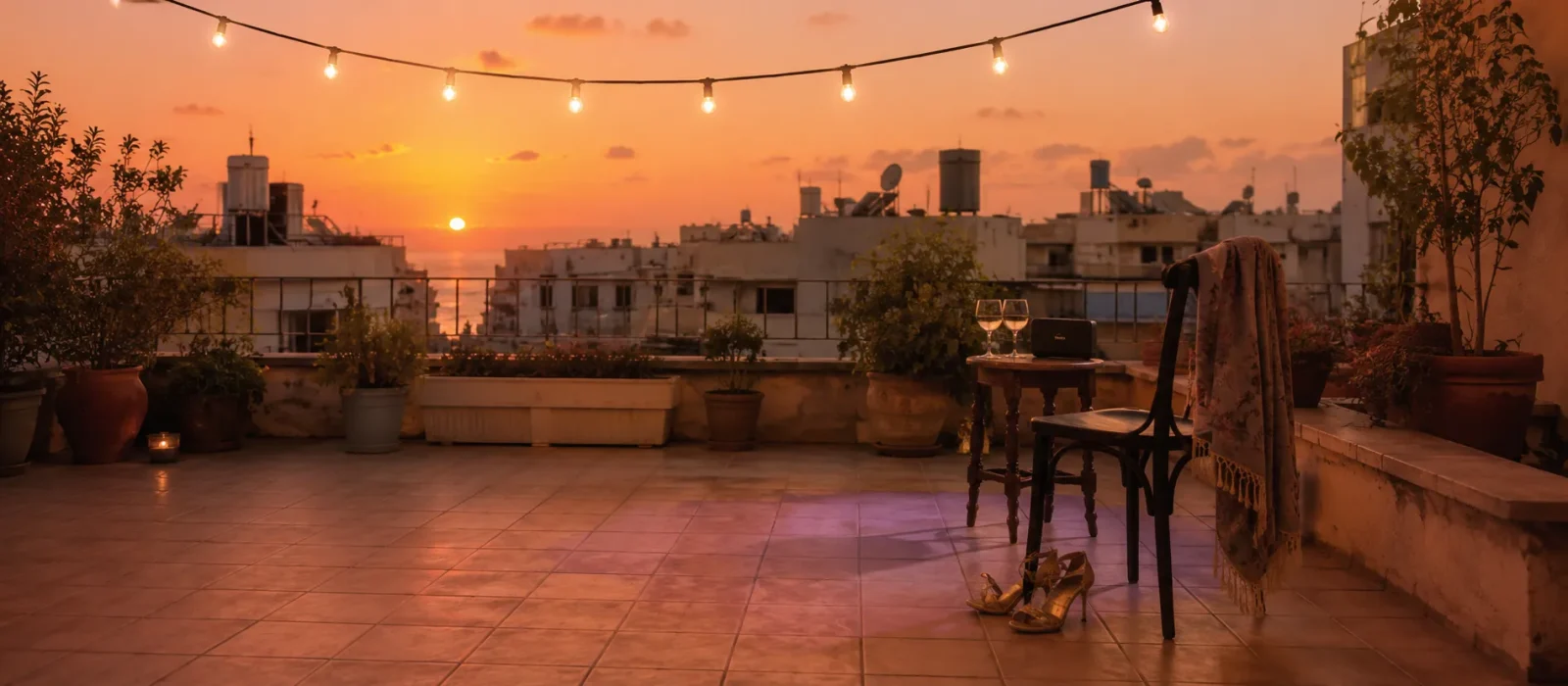
A terrace on a summer evening is where it belongs
Every style has a space that suits it better than any other. For latino it is a terrace or a roof at eight in the evening between May and October.
The reason is practical rather than romantic. This dance generates heat, and forty minutes of it in a closed living room with weak air conditioning is a worse experience for everybody. Outside, with an evening breeze, the same set looks like a different thing.
So most of its bookings come from roofs in Florentin, terraces in Jaffa and Neve Tzedek, and gardens in Bat Yam. In winter it moves indoors without trouble, but then it pays to open a window before the set rather than halfway through.
The floor matters here in a different way
For most styles we ask for a hard surface and leave it at that. Latino has a more exact requirement, because it is built on turns on the ball of the foot.
What works: tile, smooth concrete, parquet. What does not: grass, paving with gaps, decking with wide grooves, and rugs. On a surface that catches a heel the turn stops halfway, and at worst it is dangerous.
Two metres by two is plenty, which makes it far easier to place than a club set and its three by three. A small tiled balcony still works.
The hip work is technique, not accident
Worth saying, because it is the thing people see rather than the thing that is happening.
The movement comes from the knees and from weight transfer, not from the pelvis. It is learned over years of classes, and it is why not every dancer does latino even when she is excellent at other styles. With us it is led by Yonit Dror, who danced competitive salsa before she came to this work, alongside Neta Baron, Hila Mizrahi and Roni Carmel. The rest of the dancers can be filtered by style in the catalogue.
Music and what she wears
The playlist is bachata and reggaeton with a few salsa classics, and usually somebody in the group recognises at least one track. Unlike pin-up, where the recognition is nostalgic, here it is physical: anyone who has ever taken a salsa class starts moving in their chair.
The outfit is a dress with a hem that moves, a shoe with a strap that holds the foot, sometimes a fan or a shawl. There is no character and no set dressing, so all you prepare is the surface, the space and the music.
As a duo it reads differently
Two dancers in latino do not do the same thing at the same time. One leads and the other answers, exactly as in real partner dancing, and what you see between them is a conversation rather than symmetry.
In an open space the effect is strong, and it costs the ordinary duo rate. If your event is on a roof with room to move, that is our recommendation.
When to choose a different style
If the group is large and wants energy without subtlety, go-go or a club set is more accurate. If the evening is built around one person, that is lap dance. And if you are in a small hotel room with no balcony, latino will work but not at its best.
What a show costs Latino
Pick the costume in advance
You pick the costume in the message and she brings it, at no extra charge. Want something not on the list? Ask, we can usually arrange it.
- Nurse
- Cowgirl
- Waitress
- Teacher
- Flight attendant
- Secretary
- Maid
- Cat
A dancer for any occasion
What people ask Latino
Sometimes, for a few bars. The dancer leads, she chooses who and when, and it lasts under a minute. You can ask in advance for it to happen and equally ask for it not to; both requests are fine.
Go-go is a mechanical continuous tempo that works as a background to a party. Latino comes from partner dancing: it breathes, it holds eye contact and it faces outward, so it talks to the room instead of happening in front of it.
Tile, smooth concrete or parquet. Grass, gapped paving and grooved decking do not work, because the style turns on the ball of the foot and a heel that catches stops the turn.
Two metres by two is enough, less than a club set. A small tiled balcony beats a large living room with a rug on the floor.
Yes. The dance generates heat, so in a closed room it is worth opening a window or starting the air conditioning before the set rather than during it.
Yes, it is one of the styles couples book most. It is warm without being direct, and the short moment of taking part works nicely on an evening for two.
By format: 800 ILS solo, 1,400 duo, 2,200 VIP, travel, costume and music included. Cash at the end of the evening.
We cover the whole metro
What else they do
A built performance with an entrance, a peak and an ending. The reveal is the punchline rather than the content.
High energy with tempo and a crowd. It suits big groups who want something to happen rather than to watch quietly.
An entrance in character before anyone works out what is happening. The strongest style for a surprise.
Belly dance and eastern movement. It plays well to a mixed room and to events with character.
A clean line, movement close to dance, nothing crude. The one style you can put in front of a mixed group.
Leather, latex and a harness. An aesthetic rather than a session: a character, a costume and an atmosphere.
Continuous dancing with no single dramatic peak. You can step in and out of watching it.
The most intimate format. The dancer works centimetres away, with no stage and no distance.
A slow set from an experienced dancer. Less acrobatics, more control of the room and the tempo.
A fifties aesthetic: retro, playful and never crude. It suits events that want light rather than heavy.
A set from a dancer with a full figure, with no apology and no hiding. Confidence is half of it.
Pole work: strength, long lines and slow descents. It needs a pole or a high ceiling.
An outdoor set on a deck or beside a pool. Movement adapted to a surface that moves, daylight instead of dark.
Want a Latino?
Tell us the style and the time and we will say who is available.