Flat, cabin or hotel: where to hold the evening
Each of the three options has a price that is not in the photographs. Here is what each gives you and what each takes away.
Before you choose a style and before you set an hour, one decision shapes everything: where the evening happens. There are three options, and each carries a cost that does not appear in the photographs.
The comparison below is the practical one — what each place gives you, what it takes away, and who it actually suits.
A flat
The most common format, and usually the right one for a small group.
What it gives: no extra cost, convenience, and a place everyone already knows. You can book at the last minute, start early, and nobody has to travel afterwards.
What it takes: space and quiet. An average three-room flat barely clears three metres by three, and above ten people it is crowded. And beyond that there are neighbours.
The neighbour question depends on the building rather than the city. In a block from the fifties to the seventies, real bass after ten is felt on every floor. In a building from the last decade it does not carry. A rooftop flat added to an old frame is a special case: it looks new, but the slab is thin.
Who it suits: up to ten people, an evening ending around one. Styles that fit almost any flat — lap dance, burlesque, fashion.
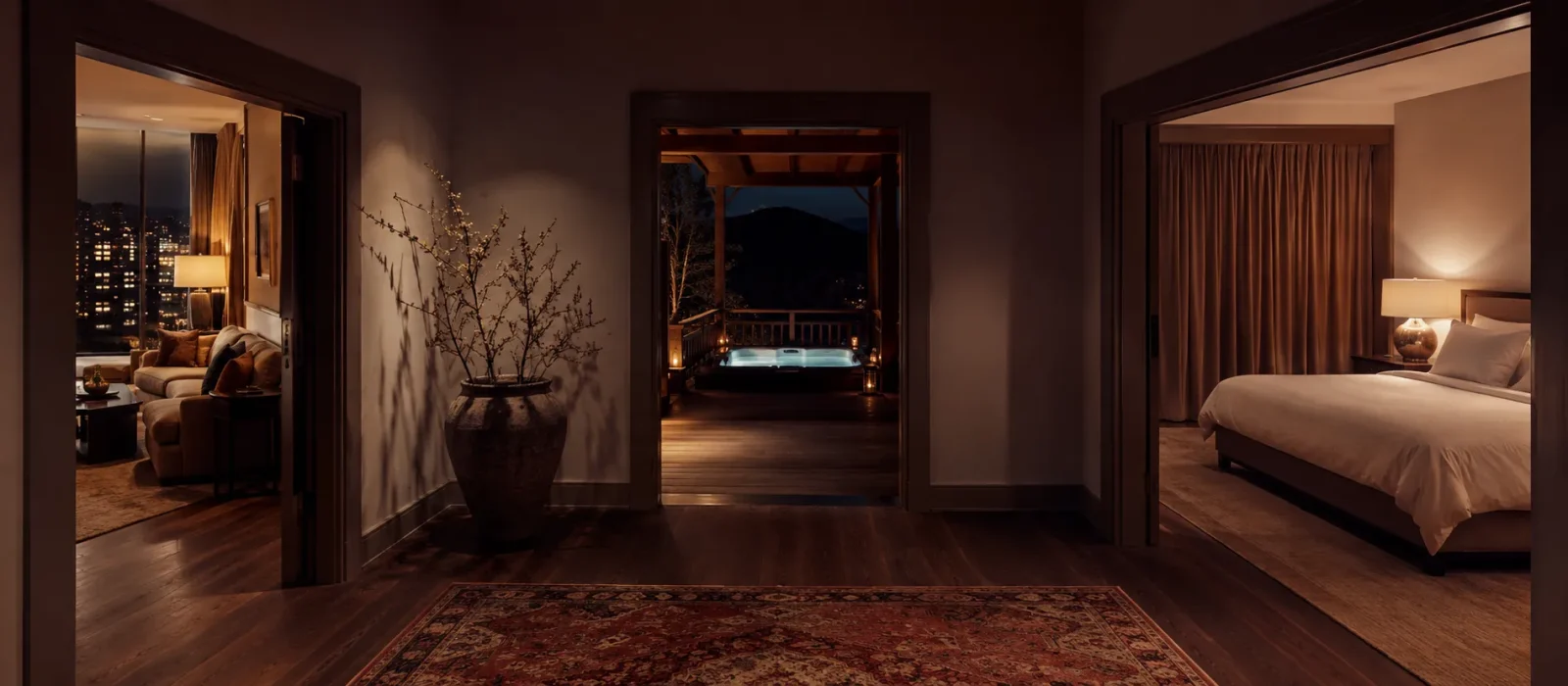
A cabin or a rented house
The format we recommend most for a large group, and it has nothing to do with price.
What it gives: real space, a yard, parking, and no neighbour through the wall. You can start at eight and finish at two. Every style is open, including a club set and go-go, which are choked in a city flat. And if the group is staying the night, nobody drives home.
What it takes: planning. A rented house is booked in advance rather than the same evening, and in season that means weeks. And there are house rules that are not yours.
Two questions to ask the owner before you book: until what hour music is allowed, and how many guests were agreed. Twenty people in a house let for ten is a story that ends badly and has nothing to do with us.
Who it suits: ten and up, a long evening, a weekend bachelor party. A duo or VIP set also fits there without crowding the room.
A hotel
The simplest format logistically and the most limited on space.
What it gives: zero preparation. Nothing to clear, no neighbours who know you, and no cleaning in the morning. It can be booked the same day, and the room already has what is needed.
What it takes: space. A standard room is three metres by four with a bed taking the middle. A group of ten simply does not fit, and even six is tight.
One more thing worth knowing: getting in. The lobby is busy, and sometimes the lift needs a key card. Our rule does not change — the room number is sent at the confirmation stage, and reception is never asked to pass on a message or call the room. More on the hotel booking page.
Who it suits: one person or a couple, sometimes up to four in a suite. The styles that work there are lap dance, fashion and pin-up. Pole does not fit and a club set will be heard in the corridor.
The decision in three lines
- Up to six — a flat or a hotel, whichever is easier for you to reach
- Seven to twelve — a large flat, or a rented house if the budget allows
- Above twelve — a house or a cabin, without hesitation. A flat will be crowded either way
If you are torn between two options, send us both. We will say which suits the style you asked for, and that usually settles it in two messages.
A fourth option: an office
Not every evening is a private one. Some of our bookings are company events at the end of a project or a leaving do, and that space behaves unlike the other three.
What it gives: room, free parking in the evening, and nobody living through the wall. A meeting room or a large kitchen area usually has more floor than a flat.
What it takes: atmosphere. Hard fluorescent light, a hard floor and office chairs are the opposite of what is wanted. Our usual fix: switch off half the lights and bring one lamp to the side.
Two technical problems that recur: the building locks early and somebody with a card has to stay to the end, and some places have a guard at the entrance who needs to know someone is coming.
The style we suggest there almost every time is fashion: no contact, nothing aimed at one person, and you can keep talking through it. That is exactly what a room holding both staff and managers needs.
A yard and a pool: a format, not a venue
A house with a yard is not simply a flat with more room. It is a different evening.
What opens up: you can be louder until ten, you can spread the evening across several hours without the room going stale, and you can have go-go or latino, both built for outdoors.
What to arrange: a dry, hard surface that is not wet tile by the water, light at eye level rather than only from inside the pool or a wall fitting above, and a towel within reach. And if most of the guests are in the water when the number starts, half the audience misses it, so time it around the food.
In winter the yard drops out entirely, and that is fine: the same house with a large living room still beats a flat.
What changes with the season
In summer a house with a garden or a pool is worth far more than a flat, and it changes the calculation entirely. An outdoor pool party is a different evening, and go-go was built for it.
In winter that advantage disappears: everything moves indoors, and a large suburban living room does the same job as a rented house. Those months are also easier for dates.
A hotel is unaffected by the season, which is quietly its main advantage.
And the price of the show
A question we get often, so briefly: the price does not depend on the venue. 800 ILS solo, 1,400 duo, 2,200 VIP — the same in a flat, a cabin or a hotel, with travel included across our whole area.
What does change is what is possible in the space. That is why we ask “flat, house or hotel” before we ask about a style.
Where evenings usually happen, by area
In Gush Dan most evenings are flats, simply because houses with yards barely exist there. In the Sharon and the Shfela it is the reverse — houses with gardens and pools are the default. In the north and the Galilee it is nearly always a cabin, and in Eilat a villa or a hotel.
If you are flexible about location that is a real consideration: the same budget buys a different kind of space twenty minutes away.
Send a message, she is on the way
Reply within minutes, cash at the end.