How to set up the room in fifteen minutes
Floor, light, a chair and a speaker. Four things decide how the evening looks, and all four take a quarter of an hour.
You have booked a show at home, and the one question still open at the last minute is what actually needs preparing. The answer is short: four things, a quarter of an hour, nothing to buy.
This is written from our side of the door. These are the things we ask for on almost every booking, and they are also the things that show immediately when they were not done.
1. The floor
The most important of the four, and the quickest.
You need three metres by three of clear floor. Not a hall, not an enormous living room — just a square you can move in without thinking about where the table is. If the room is smaller, two and a half by two and a half works too; it only narrows the choice of style.
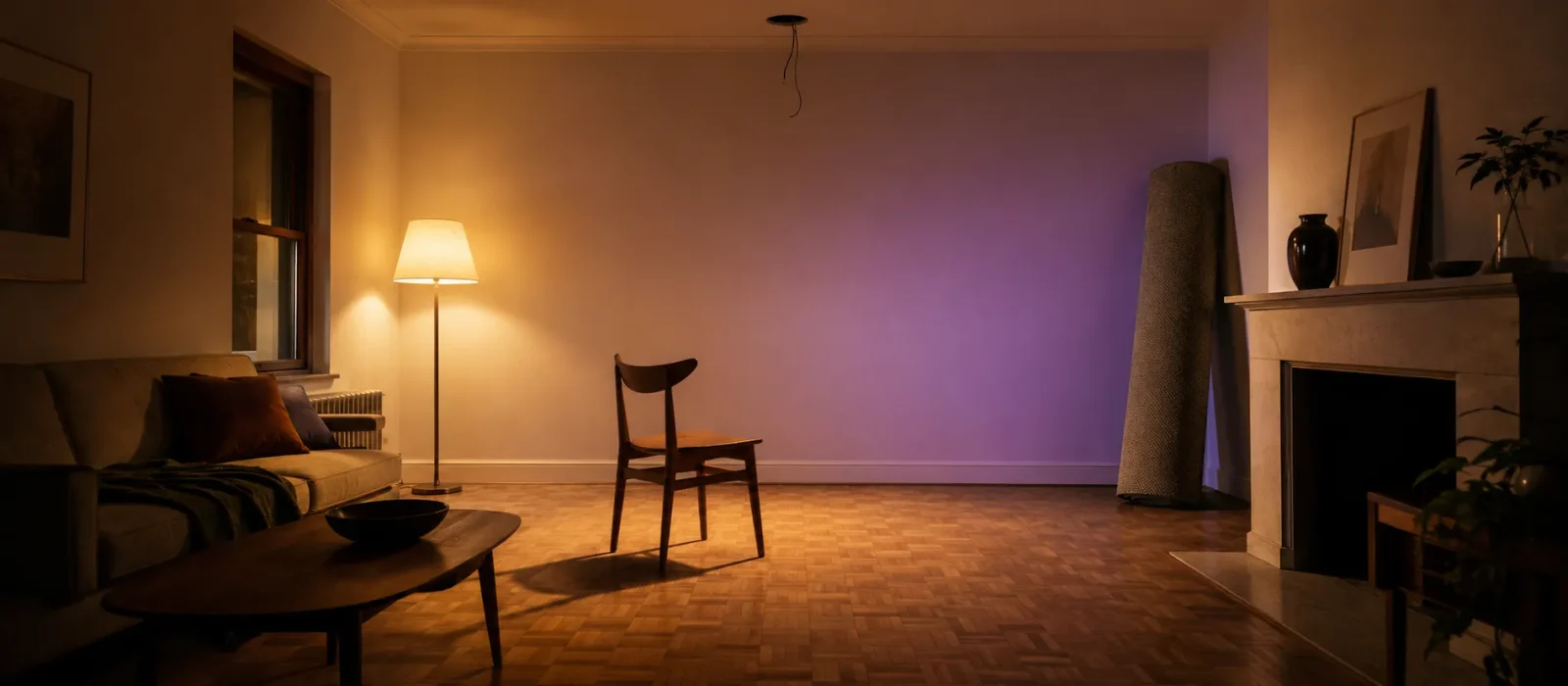
Roll the rug aside. This is the request we repeat most often. A heel catches on a thick rug, and a caught heel means either a movement cut short or an ankle. A thin, firm rug can stay; shag and anything soft cannot.
What to move: the coffee table, especially a glass one; a beanbag; cables across the floor; anything low that disappears from view when you turn. Five minutes of work that prevents the only genuinely unpleasant moment an evening like this can have.
If your floor is tile or parquet, you are already in good shape and clearing is all that is needed.
2. The light
This changes how the show looks more than anything else, and almost nobody thinks about it in advance.
Hard white light from the ceiling flattens everything. It kills shadow, kills silhouette, and leaves a room that looks like a living room at midday. Movement that looks excellent under side light looks like a rehearsal under a ceiling fitting.
What to do: switch off the main light and leave two or three low sources to the side. A floor lamp, a bulb in the corner, a table lamp moved down onto the floor. That is it.
If you have no lamps at all, light from an open kitchen or a hallway still beats the ceiling. And if you have coloured or LED lighting, keep it low, not overhead, and not flashing.
The difference between a prepared room and an unprepared one lives mostly here. It is three minutes of work and you can do it before anyone arrives.
3. A chair
If the evening includes a part built around one person — a groom, a birthday guest, whoever the evening is for — you need a chair, and not just any chair.
What works: a stable wooden or metal chair, no arms, with a straight back. An ordinary dining chair is perfect.
What does not: an armchair, a sofa, an office chair on castors, a bar stool, a plastic garden chair, a folding chair. The first two are too low and too soft; the rest are simply not safe.
Put it in the middle of the space you cleared, not in a corner. Everyone else arranges around it in an arc rather than a closed circle — an arc gives everyone an angle, a circle blocks half the room.
4. Music
The dancer arrives with her own playlist. All you need is something to play it through.
A domestic Bluetooth speaker is enough for nearly every style. Two things worth checking beforehand: that it is charged, and that it is paired to one phone rather than five — otherwise somebody gets a call mid-number and the music drops.
Where to put it: close to the dancing area, not at the far end of the room. High volume from a distance sounds worse than moderate volume from close, and it disturbs the neighbours more.
One exception: if you asked for a club set, that needs real bass and a small speaker will not do. For every other style it is fine.
Two more things that take a minute
A room to change in. A bedroom or a bathroom with a door that closes, ideally with a mirror and decent light. If you chose a style with a complex costume, such as pin-up or fetish glam, getting ready takes fifteen to twenty minutes and needs real space rather than a corner of the toilet.
Cold water. Sounds unnecessary until summer. Forty minutes of movement is forty minutes of movement, and in a room without air conditioning it tells.
How much space each style actually needs
“Three by three” is a default, and it is not right for every style. Here are the real numbers.
- Lap dance — two metres by two plus clearance around a chair. The least demanding
- Burlesque and pin-up — two and a half square, plus room for a chair and props
- Fashion — not a square but a line: a straight run of four to five metres, a metre and a half wide
- Club and go-go — three by three minimum, more is better
- Ethno — little floor but clear air above: silk travels over the head, and a low chandelier rules that part out
- Pole — a mounted pole and a clear circle of a metre and a half around it
If your room is smaller than these numbers, that is not the end of it — tell us the size and we will suggest a style that fits. That beats choosing a style first and discovering afterwards that it has nowhere to happen.
What to do when there is no space at all
It happens, usually in older flats with a small living room full of heavy furniture.
Three ways out. First: push the sofa to the wall and clear the middle — obvious in writing, and in practice most people clear the corners instead of the centre. Second: move the show to another room, even if it is not the living room. A large bedroom works well for lap dance. Third: choose a style built for a small space.
What does not work is squeezing fifteen people into a twenty-metre room and hoping. In that situation it is better to move the evening to someone else’s place or to a cabin.
Neighbours: when the volume really has to come down
We are asked this on every other booking, so here is the honest answer.
Before ten in the evening it is almost never an issue, in any building. Between ten and eleven it depends on the building: new construction will not carry it, an older block will pass bass through the floor. After eleven, in any building, loud music reaches the neighbours.
What works in practice is putting the loud part early and the quiet part at the end. Go-go at nine and burlesque at eleven give you a full evening with nobody knocking. The other way round does not.
What you do not need to prepare
Worth saying, because people sometimes go to trouble for nothing.
No professional lighting, no stage or podium, no playlist of your own, and nothing to buy. None of it improves the evening and some of it actively gets in the way.
You also do not need to clear the whole house. One clear area, the right light and a chair. That is the list.
If the evening is not at home
Preparation changes with the venue, and sometimes it is not in your hands at all.
In a hotel room there is nothing to clear: the room is small, the bed is in the middle, and the lighting is handled with two bedside lamps. It takes a minute.
In a cabin the problem is reversed — there is space, but part of the floor around the jacuzzi is wet and the lighting is usually ceiling spots. Roll the rug, move the dancing area away from the water, and switch on a side lamp if there is one.
In a rented house or villa, check with the owner until what hour music is allowed. It is the most avoidable thing to run into at ten at night.
A short list to copy
- Three metres by three clear, rug rolled aside
- Ceiling light off, two lamps to the side on
- A stable armless chair in the middle, if part of the evening is built around one person
- A charged speaker, paired to one phone, close to the dancing area
- A room with a door to change in, ideally with a mirror
- Cold water within reach
That is all of it. If anything on the list is a problem where you are, tell us in advance and we will match the style to the room rather than the other way round. The price does not change either way.
Send a message, she is on the way
Reply within minutes, cash at the end.