How many people should be in the room
Six, twelve or twenty is not a difference in chairs. It is a difference in how the room behaves and what is possible in it.
“How many of you” is the second question we ask, right after “where”. It sounds like admin and it is the least administrative question there is: the size of the group decides how the room behaves and what is possible in it.
Three sizes, three completely different evenings. Here is what happens in each.
Up to six: one room, one conversation
In a small group everyone is in the same conversation. A joke made in the corner is heard across the room, and there are no sub-groups.
What that gives you: closeness. A quiet style works, you can stop halfway and talk, and nobody needs gathering up. It is also the only size where milf and burlesque work at full strength — both are built on timing and eye contact, and both vanish in a loud room.
What it takes away: energy. Five people do not produce background noise, so styles that live on crowd response, such as go-go, fall flat. There is nobody to respond.
What suits: lap dance, burlesque, milf, pin-up. Venue: an ordinary flat, a hotel room or a suite.
Seven to twelve: the easiest size
This is the group most of our evenings are made of, and not by accident.
There are enough people for background noise and energy, and still few enough that everyone sees and hears. The room does not split, and you avoid the situation where half the guests are holding a separate conversation while something is happening.
At this size nearly the whole catalogue is open. What decides is no longer the headcount but the room: with three metres by three clear, everything is possible; without it, the list narrows.
What suits: any style, including a club set if the space and the building allow. A duo also starts to make sense here, because there is enough audience to justify it.
Thirteen to twenty: the room splits
Something changes here, and most people do not see it coming.
Above twelve the group stops being one unit. Three or four small clusters form, each with its own conversation, and when something starts, some of them simply do not notice straight away. That is not lack of interest; it is the physics of a room.
The consequence: you need something that gathers people. A style with a strong opening works better than one that unfolds slowly. Go-go and a club set were built for exactly this, whereas fashion, which is built on a precise line, starts to get swallowed because part of the room does not have the angle on it.
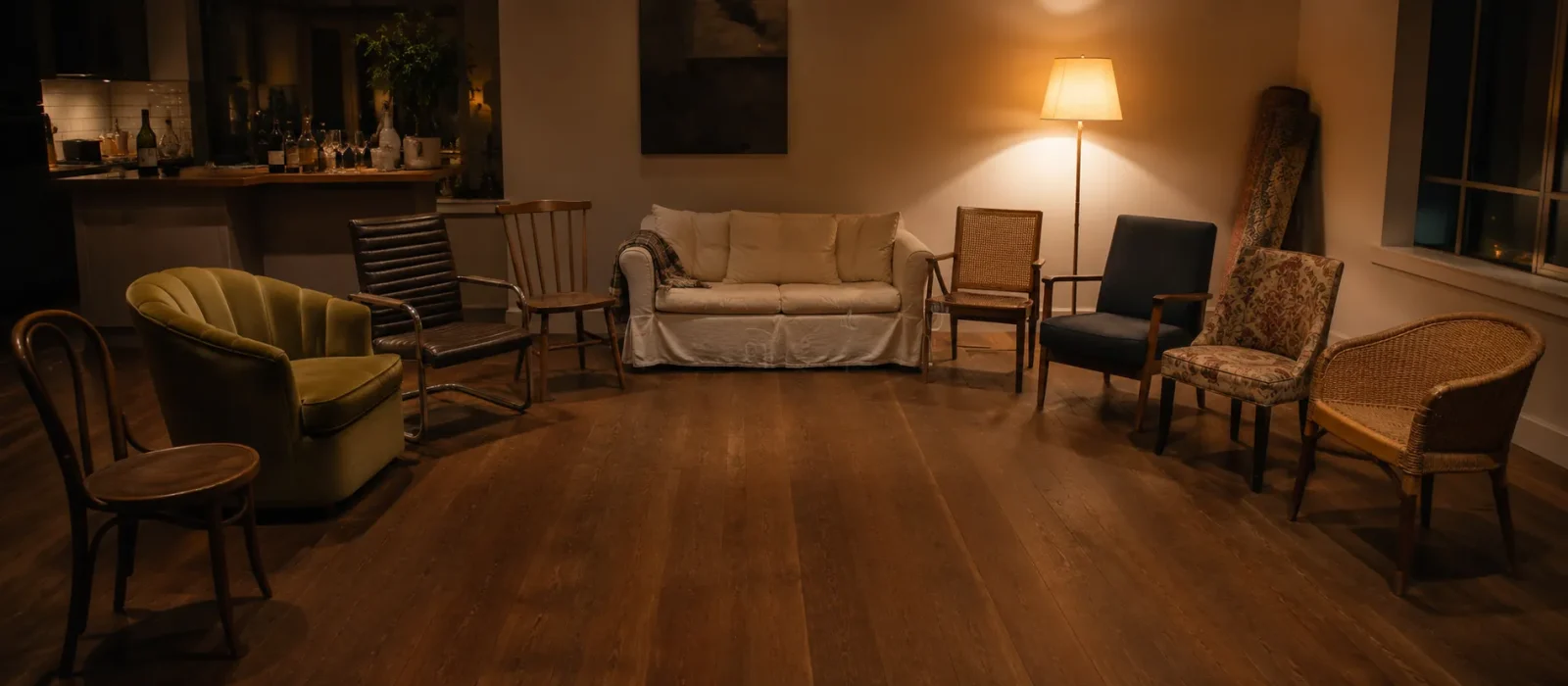
What helps: open with an energetic style and move to a quiet one afterwards, not the reverse. And arrange seating in an arc rather than a circle — an arc gives everyone an angle, a circle puts half the room behind somebody’s back.
Size also changes the hour
A point that has nothing to do with the venue and follows directly from the headcount.
A group of six assembles in fifteen minutes. A group of fifteen takes forty, and a group of twenty takes an hour, whatever the invitation said. Two people are always late, and in a large group somebody is always waiting for them.
The practical consequence: the larger the group, the later the central part should sit. With six you can start at nine; with twenty, not before ten.
The common mistake is setting the same hour regardless of size. A group of twenty that booked a show for nine gets it while half of them are still in the hallway.
Above twenty: this is an event
At that size it is a different thing, and it is worth treating it as one from the start.
A flat is no longer relevant — you need a house with a yard, a compound or a hall. The sound has to be real, because a domestic speaker does not cover twenty-five people talking. And somebody has to run the sequence, or the evening scatters into several small parties in the same house.
What we suggest at that size: a duo rather than a solo. Two dancers in a large room do not give you twice as much but something different — they cover more angles, and the group does not divide into those watching and those not.
And above thirty it is worth considering two short appearances instead of one long number. That holds attention across an evening that is long anyway.
The most common mistake: inviting as many as possible
There is an assumption that an evening with more people is a better evening. It holds up to a point and then reverses.
A group growing from ten to twenty does not enjoy itself twice as much. It loses the thing that makes a small evening good: everyone being in the same moment. So if you are torn between twelve and eighteen, take the smaller number.
One exception: if the space is genuinely large. A house with a garden and a fifty-metre living room holds twenty people without splitting; a three-room flat does not hold twelve.
What happens when more people turn up than you said
It happens on every other evening, and usually it is not a problem.
Two or three extra changes nothing. Eight extra does: the room you planned for ten holds eighteen, the clear floor disappears, and the dancing area has to be invented on the spot.
What helps is telling us a maximum rather than an optimistic figure. If you say “ten to fifteen”, we plan for fifteen, and that almost always turns out right.
And if the gap only becomes clear on the night, move furniture before the start rather than in the middle.
A mixed room: the make-up matters more than the size
Everything above assumes a homogeneous group. The moment the room holds partners, colleagues and somebody who did not entirely choose to be there, the number stops being the main factor.
In a mixed room a group of eight can be harder than fifteen old friends. The reason is simple: there is no quiet agreement about what is happening, so some of the people are watching the others rather than the show.
What works there is a style nobody has to react to. Fashion and burlesque are built for it — you can watch and you can keep talking, and nobody is in the middle against their will.
What does not work is lap dance in a room like that, unless everyone in it knows in advance and is comfortable. It is a style aimed at one person, and in a mixed room that turns into a spotlight.
How much space each size needs
- Up to six — two and a half metres square clear, enough for most styles
- Seven to twelve — three by three, plus room for everyone to see without standing
- Thirteen to twenty — three by three for the show and more for the audience in an arc, which means a large living room
- Above twenty — a house with a yard or a compound, not a flat
If you are between two sizes, send us the number and the size of the room. We will say what fits, and sometimes the answer is to invite fewer people rather than change the style.
In short
Up to six — close and quiet. Seven to twelve — the size that works best. Thirteen to twenty — you need a style that gathers a room. Above twenty — an event, and it deserves a venue built for one.
The price does not depend on the headcount, but the format does: tell us how many of you there are and where, and we will suggest what actually suits the room.
Send a message, she is on the way
Reply within minutes, cash at the end.