How to plan a bachelor party: a running order that works
A bachelor party rarely fails on budget. It fails on order. Here is what a well-run evening looks like, hour by hour.
Most bachelor parties do not fail over money. They fail over order: somebody is late, the food arrives late, the groom is drunk by ten, and the part everyone spent most on happens when nobody is paying attention any more.
What follows is a practical running order. It is written from our side of the door, after a lot of evenings seen from the inside, and you can use it as it stands.
A week before: three decisions that settle everything
Close these three early and the rest of the planning is admin.
1. Where
Not which city, but what kind of place. There are three options, and each costs something different in freedom.
- Someone’s flat — cheapest and most limiting. There are neighbours, there is an hour after which the volume goes down, and somebody cleans in the morning
- A rented house or villa — the easiest format for this kind of evening. Space, a yard, parking, no attached neighbours, an early start and a late finish
- A hotel room or suite — right for a small group, up to six. A standard room of three metres by four has no space for a crowd
Above ten people a rented house is nearly always the better call, financially as well: no damage, no neighbours, and no clearing out somebody’s living room.
2. How many people
The number matters more than you would think, and not because of catering.
Up to eight the room stays one group: everyone hears the same joke and anything that happens involves all of them. From ten to twenty the room splits into clusters, so you need something that gathers everyone back. Above twenty it is no longer a bachelor party but an event, and it needs a venue built for that.
3. What the core of the evening is
A party without one central event fades out around eleven. A game, a surprise, a show, a night drive — one thing everybody is waiting for.
What does not work is three central events in one evening. The second feels like a repeat and nobody remembers the third.
The running order, hour by hour
The times below assume an evening starting at eight. If you start later, move everything, but keep the gaps.
20:00 — people arrive
Nobody arrives on time, and that is fine. Plan forty minutes of arriving and schedule nothing inside it. Whoever is organising should be there first, not last.
What happens here: a beer, music in the background, and the group meeting each other. What should not happen is serious drinking.
20:40 — food
Food at the start, not in the middle. A group that has eaten drinks differently, stays sharper, and the evening lasts two hours longer.
If you ordered delivery, make sure it arrives before your stated hour rather than exactly on it. A delivery half an hour late ruins everything scheduled after it.
21:30 — the main part
This is where the central event belongs, for a simple reason: the group is complete, has eaten, is in the mood, and is not yet tired.
If the central part is a show, half past nine to half past ten is almost always the right window. Too early and the room has not warmed up. Too late and part of it has checked out, which is a waste mostly for you.
22:30 — a gap
After the peak you need a quarter of an hour of nothing: out to the balcony, another bottle open, a conversation. Cram another activity in there and it will fall flat.
23:00 — the second half
This is where games, cards, the pool or simply louder music belong. It is the part you can let run without a schedule.
00:30 — a planned ending
An evening that ends by decision beats one that fades. Anyone who wants to carry on carries on in town, and that is no longer the organiser’s problem.
Who organises, and why it has to be one person
This is the most common mistake we see: the group organises in a group chat, everyone suggests, nobody closes anything.
You need one person who owns the arrangements: he books, he takes the confirmations, he opens the door, and he is the only one who knows the full timetable. Everyone else turns up and enjoys it.
There is a second reason. If the evening includes a surprise for the groom, a ten-person group chat is the surest way for him to see something on somebody’s screen. We deliberately correspond with one person for exactly that reason, and we also ask not to be saved in a phone under a name that gives it away.
Budget: where not to save
A bachelor party works on any budget, but there are three places where saving costs you.
The venue. A flat too small for the group ruins the whole evening, and no amount of money later fixes it.
The food. A hungry group drinks fast and scatters early.
The central event. If you chose one, do it properly. Half an event is worse than none.
Where you can save: expensive spirits, decorations, and anything that would only be remembered in photographs that will not be taken.
What to prepare at the venue
A short list that covers nearly every scenario, all of it five-minute work.
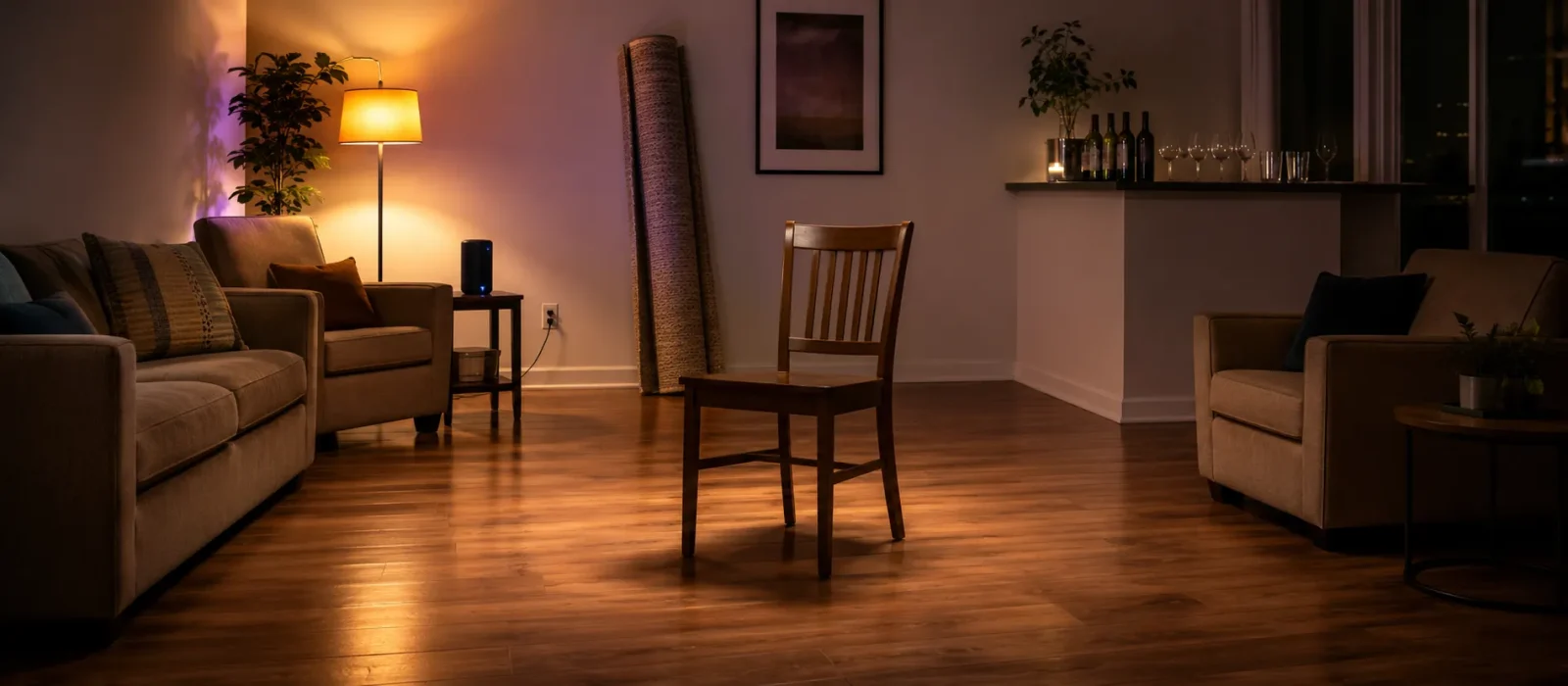
- Clear a space in the middle of the living room and roll the rug aside
- Switch off the ceiling light and leave one or two lamps to the side
- Check there is a speaker and that it is charged
- A stable chair without arms, if the evening includes anything happening around the groom
- One closed room that can be used, not just a bathroom
- Cold water within reach, especially in summer
If the evening is at a cabin or a rented house, check two things with the owner beforehand: until what hour music is allowed, and how many guests were agreed. Those two questions prevent the most avoidable problem an evening like this can have.
Where to hold it, by area
If the group is flexible about location, the area changes what is possible.
In Gush Dan everything is close and a venue can be found at the last minute, but flats are small and parking is difficult. In the Sharon and the Shfela there are houses with gardens and pools, which is the format that suits a large group best. In Eilat you are talking about a whole weekend rather than an evening.
Three mistakes that keep repeating
Scheduling everything for the same hour. Food, event and games all at nine means none of them happens properly.
Starting to drink at seven. A groom who started early does not enjoy the evening you planned for him, and that is a waste mostly for you.
Telling nobody the plan. The surprise is kept from the groom, not from the group. If nobody knows what is happening, nobody helps either.
In short
Settle the venue, the headcount and one central event a week ahead. Allow forty minutes for people arriving, feed the group early, put the peak around half past nine, and let the evening end by decision rather than exhaustion.
And if the evening includes a show, send us the hour, how many of you there are and where it is happening — we will say straight away what suits the room and what does not. The price comes in the first message, and payment is cash at the end.
Send a message, she is on the way
Reply within minutes, cash at the end.