How not to spoil the surprise
Most surprises are not blown at the last moment. They go during the week, and always in the same three places.
Surprises are rarely blown at the last moment. They go quietly during the week, and always in the same three places: the group chat, the contacts in your phone, and the way into the building.
This is a map of those three points. It is written from our side, because we see the result — and the difference between an evening where the surprise worked and one where everybody knew and pretended otherwise.
First point: the group chat
This is the number one cause, by a distance.
The group opens a chat to organise, and within two days it holds seven people who also message the guest of honour separately. It takes one screenshot with “look what they are planning”, or one notification on the screen of somebody sitting next to him.
What to do instead: one person coordinates, and the group chat carries only the time and the place. Everything about the surprise itself goes in private messages with the two or three people who need to know, not with everyone.
That is exactly how it works on our side: we correspond with one person. Not because anything is hidden, but because every message sent to a group is another chance for somebody to see it.
Second point: the name in your phone
The smallest and the most surprising.
You save a contact under a name that explains itself, and then a message arrives while the guest of honour is sitting beside you. A notification on a locked screen is readable from a metre and a half away, and even people who are not trying to read it do.
What to do: save it under a neutral name, and turn off message previews on the lock screen for that week. Two actions, ten seconds each.
And if the surprise is a week away, do it now rather than on the day. Most of these go wrong in the days before, not on the day itself.
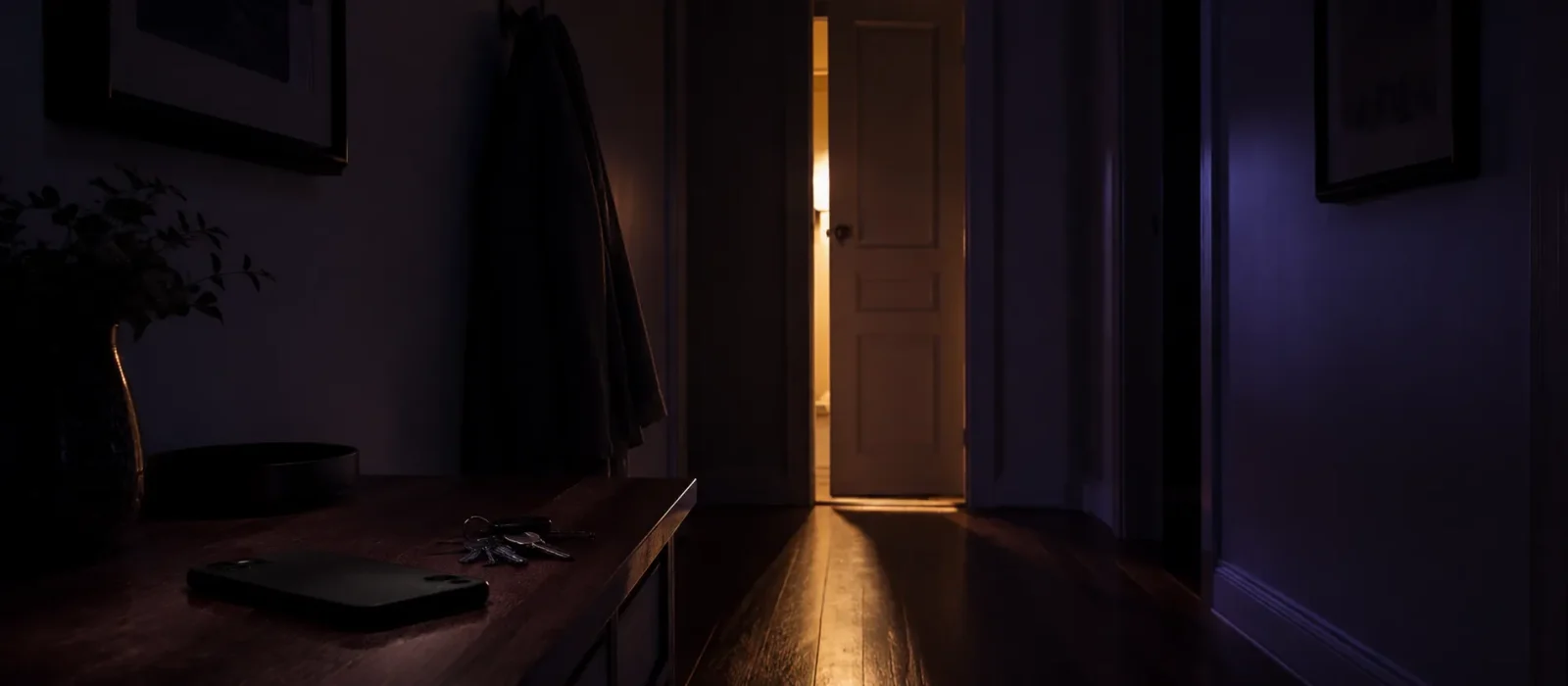
Third point: the way in
This is where most evenings actually break, and it has nothing to do with secrecy and everything to do with logistics.
If somebody is arriving from outside, they need to come in once, at the right moment. What happens when that is not planned: she stands on the street, calls, somebody hunts for a phone, the group notices, and the guest of honour is watching the door before anything has happened.
What to arrange in advance:
- One person who knows the hour and comes out to meet her — not “somebody will hear the bell”
- The gate or car park code sent in advance, not while she is standing outside
- In a building with a lobby, go down and come up together rather than using the intercom
- Parking nearby if possible. Two hundred metres along a street is exactly where surprises end
And at a private house it is the gate. A street intercom does not always work, and a dark yard with a long path adds another five minutes of waiting.
A special case: cosplay
If you chose cosplay, everything above becomes critical.
The dancer arrives already in character, in full costume. She cannot wait in a lobby, cannot cross a full living room on her way to get ready, and cannot stand on the street for five minutes. The whole point of the style is the thirty seconds in which nobody understands what is happening — and those are gone the moment she has been seen beforehand.
So there we ask for a reserved space nearby and somebody already waiting at an open door. That is not fussiness; it is the condition for the style working at all.
Timing: when exactly to bring the surprise in
A question about the hour rather than about secrecy, and most people get it wrong in the same direction.
Too early and the group is not complete, half of them are still in the hallway with coats on, and the moment scatters. Too late and the guest of honour has drunk enough not to retain it, which is a waste mostly for you.
The window that works is roughly ninety minutes after the group gathered, and after they have eaten. In an evening starting at eight that lands around half past nine, which is also the hour we suggest almost every time.
One more small thing: do not park the guest of honour by the door at that hour. It sounds obvious and it happens every time — somebody calls him over “for a second”, and he turns towards the entrance at exactly the wrong moment.
What to tell the group and what not to
There is a balance here that people do not always catch.
The surprise is kept from one person: the guest of honour. The rest of the group needs to know what is happening, when, and who opens the door. A group that knows nothing cannot help, and somebody will certainly do exactly the wrong thing at the wrong moment because they had no idea there was a plan.
What is worth telling them in advance: do not photograph anything, do not discuss it in the group chat, and do not park the guest of honour next to the door at ten.
Surprises for a birthday rather than a groom
Most of what is written above assumes a bachelor party. A birthday works slightly differently and it is worth naming the differences.
The room is usually mixed: partners, colleagues, sometimes relatives. That changes not the logistics but the choice — a strong surprise in front of a room that did not expect it can land badly rather than well.
What we suggest for that case is a style that nobody has to react to: fashion or pin-up. Both can be watched from across the room while people keep talking, and neither singles anybody out. The surprise stays a surprise without becoming a test for the guests.
And if the birthday is a milestone with a wide age range, tell us — it changes what we bring more than the date does.
And if the surprise is already blown
It happens, and nothing needs cancelling.
An evening where the guest of honour knows is still a good evening, just a different one. What is lost is the effect of the entrance; everything else remains. If it happens the day before, it is worth considering a change of style: cosplay without a surprise loses most of its value, while burlesque or lap dance are barely affected.
What is not worth doing is pretending. A group performing “we know nothing” while everyone knows creates precisely the awkwardness they were trying to avoid.
In short
- One person coordinates, not a group
- A neutral name in your contacts, lock-screen previews off
- Codes and gate details sent in advance
- Somebody comes down to meet her, no intercom and no waiting on the street
- The group knows everything, the guest of honour knows nothing
If you are planning an evening like this, tell us who the contact is and which way to come in. The price and the hour come back in the first message, and the room number or the code is handed over only at the confirmation stage.
Send a message, she is on the way
Reply within minutes, cash at the end.