Guest etiquette: what to do and what never happens
Most guests do not know how to behave, and not because they are rude. Nobody ever explained. Here is the explanation.
Most guests at a private show do not know how to behave, and not because they are rude. Nobody ever explained, and it is an evening with no clear cultural script.
So here is the explanation, as it stands. The rules below are the same in every style, every city and at every price, and they do not change according to how much you have had to drink.
Contact: she decides, not you
This is the one rule with no softened version, so it goes first.
Guests do not initiate contact. The dancer sets the distance, she is the one who comes closer and moves away, and she is the one who ends the set. That holds even for lap dance, the closest style we run — if anything the line is clearest there.
What is entirely fine: sitting, watching, reacting, laughing. A guest who reacts naturally turns a good evening into a better one. A guest who tries to “help” stops it.
And if somebody in the group is unsure what is allowed, the simple answer is to ask her. She will say, and no awkward moment is created.
Phones
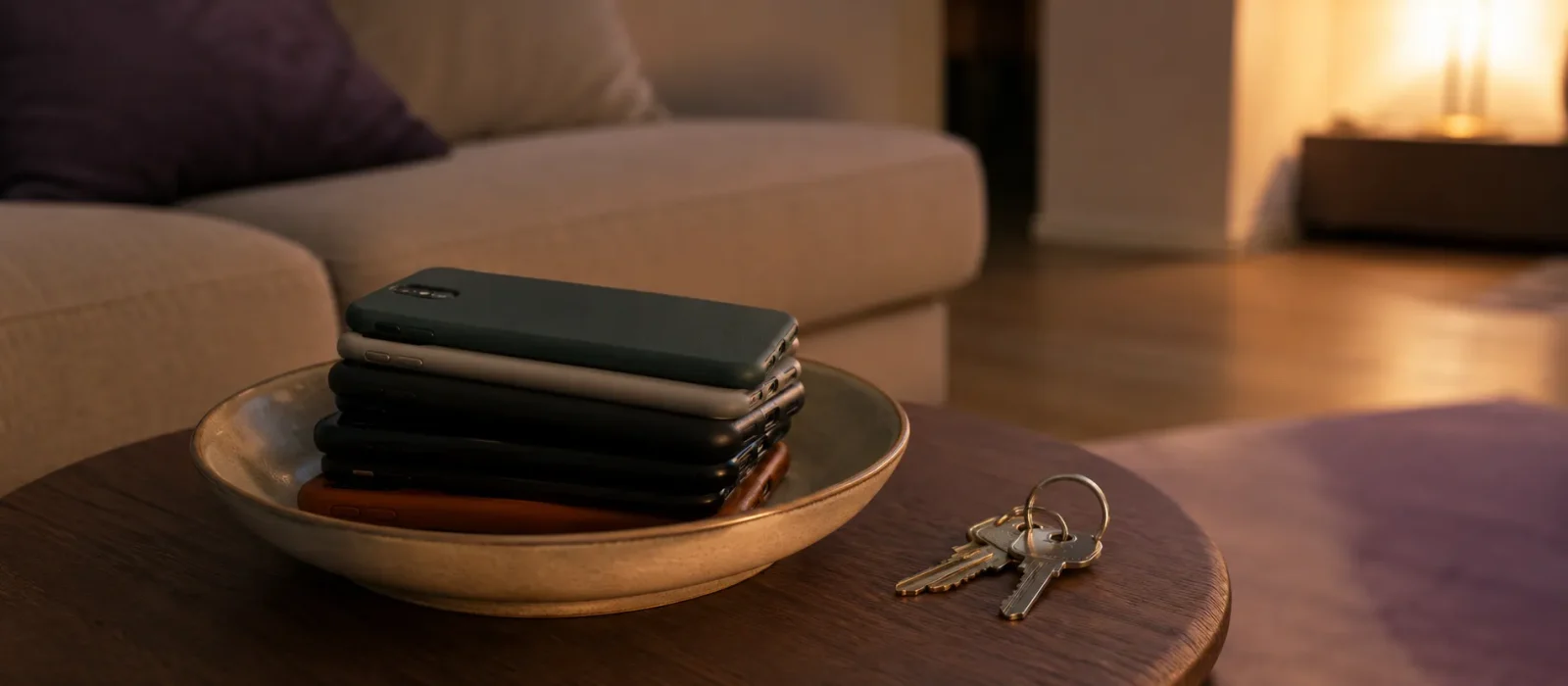
Phones go down before the number starts. Not in a pocket, not face down on the table “just in case” — simply not in anyone’s hands.
The reason is practical rather than moral: it is the condition that lets a dancer work close and stay comfortable. The moment there is a camera in the room, the set becomes more careful, and that is felt.
It applies to filming from across the room, to a story of “just the lads”, and to a dark garden. We say it in advance on every booking so that there is no uncomfortable moment halfway through.
What is fine: photograph the group before and after. Your evening, your pictures — just not during the number and not of the dancer.
Distance and seating
A section that sounds technical and changes the quality of the evening more than anything else.
The right arrangement is an arc, not a circle. In an arc everyone sees and nobody is behind anybody. In a closed circle half the group is looking at the back of the other half’s heads, and the dancer is in the middle with no clear direction to work towards.
What does not work is closing in as it goes. A group that shifts forward a metre every minute shrinks the floor, and it ends with nowhere to move. If you sat back, stay back.
And if the set is built around one person, everyone else does not crowd him. It is his moment, and an audience pressed around him makes it cramped rather than central.
Drinking
Nobody expects you to sit there sober, and that is not the idea.
What is worth knowing: a group that started drinking at seven does not enjoy the evening it planned for itself. By the time the show starts half of them are no longer paying attention, and the part they spent most on passes them by.
The practical advice: eat early, put the central part around half past nine, and leave the serious drinking for afterwards.
And if somebody overdoes it anyway, there is no need for drama. It helps to have one person in the group who stays clear-headed until the central part is over — he is the one who talks to us and opens the door.
Payment
A subject that creates unnecessary awkwardness, so we will close it in three lines.
Payment is cash at the end of the show, by whoever booked. No deposit, no payment up front and no card. The price given in the first message is the price at the end of the evening, with no additions and no service charge.
What does not happen: separate payments to the dancer on the side, extras midway through, or negotiation over something that was not agreed in advance. If somebody in the group offers money for anything additional, the answer is no, and it is not a question of the amount.
What is refused, and why it is written out
There are three requests we always turn down, and they do not depend on the style, the price or the group.
The first: anything beyond a dance set. It is not a question of the amount or of a particular dancer; it is what the service is. Anyone looking for something else will not find it here, and we say so in advance so that nobody wastes their time.
The second: filming. Already covered above, but worth repeating, because it is the request that comes up most during the evening itself.
The third: pressure on another guest. If somebody in the group does not want to take part, he does not. The group does not push him into the middle “for the laugh” either, and the dancer will not do it. We will say so gently on the night if it comes to that.
If you are the guest who is uncomfortable
Every group has one, and sometimes it is whoever is reading this.
There is no obligation to take part. You can sit to one side, you can step out to the balcony, and you can simply watch without reacting. Nobody will pull you into the middle or ask you to do anything — that is not the kind of show this is.
And if your group is mixed and some of them are not used to this, tell us in advance. There are styles built for exactly that room: fashion and pin-up are aimed at nobody in particular and you can keep talking through them.
What we do on our side
So that it is symmetrical.
We arrive at the agreed hour and tell you in advance if anything shifts. We do not call reception and do not announce ourselves at the door. We do not add to the bill at the end. And we ask guests for nothing beyond the three things written here: no initiated contact, no cameras, and no closing in as it goes.
Everything else — the noise, the laughing, the reactions — is your evening, and that is how it is supposed to look.
In short
- No contact initiated by guests; she sets the distance and ends the set
- Phones down before the number, with no exceptions
- Sit in an arc rather than a circle, and do not close in as it goes
- Drink as much as you like, but it pays to be present for the central part
- Cash at the end, from whoever booked, with no additions
Anything else is collected in the FAQ, and it is the same for every style and every area.
One rule for the host that outranks the rest
Everything above works twice as well when the group hears it from you and not from her. Thirty seconds before the doorbell — phones away, no touching, the man of the hour sits where he is put — lands as house rules. The same words said mid-show land as a scolding, and the room needs a few minutes to get its mood back.
It does not have to be formal. One line over the music while the drinks are poured does the job, and the evening keeps its own momentum instead of borrowing hers.
Send a message, she is on the way
Reply within minutes, cash at the end.